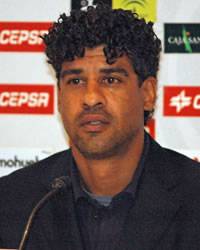
Rijkaard’s Leaner, Meaner Barcelona?Now that the sleeping colossus that is FC Barcelona is waking from its short summer to stretch pre-season muscles, Coach Frank Rijkaard is back in the spotlight. The Dutch tactician has made his first comments on the upcoming season and his reformulated squad, but perhaps more than ever he’s facing the toughest test of his coaching career. With fans and the press demanding not just results but stylish ones, and in the light of recent events, Frank is changing things at Can Barça…but can we expect a leaner, meaner Barça or is the temptation towards star names too much to resist…?Almost exactly a year ago, the 2006-7 season started with high hopes that the fabulous double-tap of Champions League and Spanish Liga successes would herald a glorious season for FC Barcelona. Signings were discrete as Laporta and the Barça board decided not to rock the boat by bringing in players who would threaten the first team players who’d touched the European sky for the first time since Cruyff in 1992.
The rest is history, but not the sort that dreams are made of. The start seemed to show that the 2005-6 triumphant march would continue without a break in the Blaugrana stride, more so as Capello’s second stint at the Bernabéu soon turned very sour. But soon enough the troubles started to pile up. A plague of injuries, very public washing of dirty laundry, unhappy stars, plus a worrying inability to avoid frittering away key points led to the unthinkable.
Premature exits from the Champions League and the Copa del Rey were compounded by a league slump and Real Madrid ended up breaking their trophy drought on the last matchday. Barça had a better goal average (78 for, 33 against) than Real Madrid (66 for, 40 against), but that frustratingly idiosyncratic Spanish head-to-head rule meant that the tiebreak lay in the Merengues’ 5-3 aggregate edge over the Blaugranas…and equalled the Liga title.
It was a punch to the solar plexus that left Rijkaard and Laporta’s FC Barcelona winded and empty-handed instead of standing proud over a glittering array of silverware. The current season started with the Coach facing a stark challenge for the first time since halfway through his first year in Catalunya. The President has set the scene with two sea changes to the way things were kicked off a year ago, specifically designed to give Rijkaard a last chance.
The first is by bringing in sought-after players rather than appealing bargains who will expect starting places in the team…and be prepared to fight for them. In contrast to last season, Laporta has invested heavily in reinforcements. Thierry Henry (€24 million), Yaya Touré (€9 million), Eric Abidal (€15 million) and Gabriel Milito (€17 million) are expected to heighten competition for a place in the sun.
The second is the so-called ‘ten commandments’ handed down by Laporta and sporting director Txiki Begiristain. The ex-striker explained to Catalan daily ‘El Periódico’ the motives behind implementing a series of rules and regulations. "The main idea is that everyone turns up in the morning in prime conditions and to allow players to know exactly what is permitted and what isn’t.”
"There’ll be a body that will apply sanctions for serious infractions, and that could be via the club infrastructure or in the dressing room itself…but that doesn’t mean that we’ll assign a policeman on each player", stressed the exec. "Sometimes the three Captains can’t cover every aspect so we’ll create a committee of five players who’ll be a group that hold sway over the dressing room", he added.
Txiki went on to underline that "we’re expecting an immediate reaction…let’s see if this team has a sense of guilt. Nobody can live in the past, least of all here." The inference is clear: professionalism has been lacking – or limited to personal concerns – and that some players had been indulging in the nightlife and that won’t be permitted this season as it weakens the team. The approach is similar to that adopted by Brazil after the Germany 2006 fiasco.
Father-figure Parreira was replaced by Spartan Sergeant Major-turned-General Dunga and the results have spoken for themselves…so far. Despite cutting some of the biggest names from his first team – either benching them or not calling them up – and being hit by ‘betrayals’ such as certain players crying off the Copa América in favour of holidays, despite injuries and despite heavy criticism of his ultra-defensive style, Brazil won the Cup against an attacking and lauded Argentina.
Dunga and Rijkaard have many similarities: they’re just thirteen months apart in age (Dunga the younger man), both played as holding midfielders (Rijkaard was recycled by Sacchi at AC Milan after his centre-back origins at Ajax) and both met face-to-face on the pitch with their Italian clubs and in the World Cup 1994 last sixteen match at the Dallas Cotton Bowl where a conservative Canarinha squeezed out a juicy attacking Oranje 3-2. Nevertheless they are poles apart in their coaching approaches.
Rijkaard has always preferred a more offensive slant to his line-ups whereas Dunga has increasingly gone for shoring up the rearguard rather than upping the ante by bringing on more artillery. This approach was successful (despite the hail of criticism from Brazil) in Venezuela – although the differences between national and club level, a short tournament and a lengthy league are self-evident – and also echoed last year’s Spanish experience.
Fabio Capello was slammed and insulted in a similar way to Dunga by the press and fans seeking a more attractive game from their team, but the now-fired Italian did fire up his men as underdogs with a point to prove to their critics in a way that Dunga also did in the Copa América. They may not have reached footballing fantasy-made-reality, but both delivered the silverware against the grain of what was predicted for most of the competitions they played.
Looking back just over a year ago, this time to the World Cup, Brazil were supposed to have a fantastic four up front that would demolish all-comers…but Parreira saw his abandonment of the staid, no-frills 1994 approach flop fantastically as the Seleção bowed out via a Thierry Henry goal. The post-mortem of the disappointing ejection blamed prima donna star behaviour and a lack of collective guts, sacrifice and determination in the team: just what Dunga was brought in to re-establish.
Nevertheless, the arrival of long-time target Thierry Henry has prompted Pavlovian salivating amongst fans and journalists about a ‘fantastic four’ up front, either in a 4-2-3-1 / 4-2-1-3 or a 3-4-3 (Ronaldinho; Messi, Eto’o, Henry in the formations with the Gaúcho supposedly slated to sit behind the new trident), and although Rijkaard has said that there is a mathematical possibility of fielding all four at once he’s still keeping his cards close to his chest.
Barcelona daily ‘El Mundo Deportivo’ has postulated ideas on the subject, including the concept of following the hypothetical 3-4-3 that Bayern Munich may use this season under Ottmar Hitzfeld…if the most optimistic fans had a say: Kahn; Sagnol, Lucio, Lahm; Van Bommel, Schweinsteiger, Zé Roberto, Ribèry; Podolski, Luca Toni and Klose. But “It’s difficult that Frank Rijkaard follows this hypothetical formation at Barça”, the Spanish paper observes.
“Barça didn’t win anything last year, it’s true, but the 4-3-3 has worked well for Rijkaard and fielding Messi, Eto'o, Ronaldinho and Henry means that Deco, Xavi or Iniesta would have to be benched…and that talent in midfield is key…Henry is the newbie and should fight for the number 9 spot with Eto’o…Puyol’s injury may bring Márquez back into central defence for the start of the Liga with Touré Yaya in front of the defence.”
The FC Barcelona hierarchy is also cautious about getting up hopes as to an all-singing, all-dancing fantastic four and Txiki told ‘El Periódico’ that "whoever has to wait [on the bench] should be professional and understanding." Rijkaard is following suit…with a commendable mea culpa as he leads by example. “I believe that we are starting from zero, myself as much as the team…I’m thrilled and happy to have this challenge”, he explained.
The sea change was also shown as he met with the players in private rather than having a bombastic presentation to reunite the players. The keys are seen as humility, effort, self-motivation, collective pride and love for the club colours and the players were informed of that in a no-nonsense yet non-aggressive manner. It’s not a zero-tolerance policy, but mouthy whiners and physical stragglers will find precious little sympathy – or space.
This post has been edited by zvintik on 22 Jul 2007, 18:08
მიმაგრებული სურათი


 ·
·  FC BARCELONA Fan Club, Mes que un club !