Leo is the Fifth sign of the Zodiac. Its name may derive from the Latin leo or the Greek leon, both of which mean "lion." However, the name is likely Semitic in origin...from the Hebrew word, labi. Leo is known as the "royal sign," symbolic of exuberance and leadership, and individuals who fall within its jurisdiction place courage and personal honesty above all else. Others may not necessarily fulfill the expectations of a Leo native and thus, the life of a Leo is often rife with disappointments. There is a radiant warmth associated with this Zodiac Sign which emanates from the Leo personality to touch the hearts of friends and admirers. This fortunate personality trait is apt to open many doors in life and the individual ruled by Leo welcomes both authority and responsibility. The fiery temperament of a Leo subject is typical of the Zodiac's fire group...fire being the element which rules this sign. There are few people who fail to be attracted to the Leos of this world since they are indeed likeable individuals, being frank, open, honest and endearing. Of all the Zodiac Signs, it is Leo which is most known for dedication to an ideal. There is a tendency here toward a drowning in egocentricity and materialism, coupled with a lack of both the desire and the capacity for spiritual development. Thus, those born under the Sign of Leo should strive to avoid the type of exaggeration that can debase their many inherent gifts.
The symbol...or glyph...of Leo has, since ancient times, been likened to the mane of a lion, or even its tail. However, it has also been thought to represent the two valves of the heart...the area of the body which Leo rules. Yet other interpretations of the glyph are that it is representative of the "serpent power" or creative force of the body in its coiled or dormant form, or that it symbolizes the heat or creative energy of the Sun, the celestial body which governs this Zodiac Sign. In Vedic Astrology, this glyph represents creativity and childbirth, likened to a sperm cell which is the creative power of life and heralds its beginning.
Also known as the Sign of the King or President, Leo is Positive in polarity (as are Aries, Gemini, Libra, Sagittarius and Aquarius). The general characteristics of Positive Signs broadly match those for the extrovert personality and such individuals are naturally more impulsive, buoyant, communicative and sociable than are the Zodiac Signs of Negative polarity (Taurus, Cancer, Virgo, Scorpio, Capricorn and Pisces). However, Positive Signs rarely display the same levels of sensitivity or the same depth of understanding of emotional subtleties as do their Negative counterparts. Positive Signs tend to crave excitement and thus, are inclined to direct their energies outward into the world around them. Aries is the most flagrantly extrovert of the Positive Signs (with Sagittarius a close second).
All Zodiac Signs governed by the Elements of Fire and Air are considered to be Masculine in nature. Thus, Leo (ruled by fire) is considered Masculine (as are Aries, Gemini, Libra, Sagittarius and Aquarius). Masculine signs are traditionally conceived as being more active and less receptive than their Feminine counterparts which are ruled by the Elements of Earth and Water (the Zodiac Signs of Taurus, Cancer, Virgo, Scorpio, Capricorn and Pisces). Masculine Signs focus primarily on spirituality and activity...both in the physical sense and mental sense. Masculine Signs are said to be diurnal or day-oriented. Therefore the term "masculine" should be viewed in the same light as the Yang (or bright) Polarity of the Tao.
Leo is the natural ruler of the Fifth House of the Zodiac, often referred to as the "House of Pleasure" and known in Vedic Astrology as the "Good Fortune." This is the field of experience in which an individual is challenged to develop creativity and self-esteem...and to find joy in living. Essentially, it deals with fun, games, gambling, playing, acting, drama, hobbies, the theater and the use or misuse of creative energies. The side of an individual which is reserved for play...the side which only emerges when there is fun to be had and the work is done...resides in the Fifth House. By its very nature, this House reflects the charming and delightful side of an individual...where hobbies, interests and playmates may be found. In short, if something provides a person with joy, then it will be preserved in the Fifth House. By tradition, this House is associated with children, enthusiasm, creativity and motivation, as well as love affairs...both legal and illicit. The influence of the Fifth House creates a sense of excitement and the craving of pleasure. It also allows an individual to see a little of himself or herself in what has been personally created...anything from the smile of a son or daughter to a piece of artwork. The Fifth House is governed by the Planet Sun...not truly a "planet" since it is a star, but classified as such for the purposes of continuity in the science of astrology.
* * *
Virgo is the Sixth sign of the Zodiac. It heralds the end of Summer and nearing of the harvest. The origin of its name has become lost over time but among European and Middle Eastern mythology, Virgo has always been a symbol of fertility and a representation of the production of crops. Even in prehistoric times, this Zodiac Sign was perceived as both a mother and a virgin. According to some astrological sources, Virgo's original symbol was the Sphinx...mythological poser of riddles...and, indeed, those governed by Virgo are prone to question, turning inward in order to seek larger meanings about causes and purposes in life. Some sources maintain that Virgo began as The Great Mother, a Sumerian Corn Goddess, while in Egypt, she was Nidaba, Goddess of Grain, whose harvest begain when the Moon was in her constellation. In medievаl times, Virgo was associated with the Virgin Mary. However, in most depictions, Virgo holds sheaves of wheat or an ear of corn, emphasizing her role as a Goddess of Fertility and Agriculture. Occasionally portrayed as bearing flowers, this image may be a reference to Mi, her Babylonian name, which means "cluster of flowers." Virgo natives seek complete realization of the mind, being logical, practical and methodical with an intellect which subrogates the instinct. This is an unassuming Sign, but one which rules hard-working individuals who are prepared to serve unflinchingly and give of their hearts. Those born under the Sign of Virgo should strive to expand their perspective beyond details...to see the larger order and underlying pattern of creation. Thus, those who accomplish this will know the goals worthy of service and learn how to temper intellect with reverence.
The symbol...or glyph...of Virgo is said to be connected to the Immaculate Conception of the Messiah and marks out the letter "M" or the letters "MV" (for "Maria Virgo" or "Virgin Mary"). It is generally assumed to have originated from the star Spica found in the constellation of Virgo and is indicative of female virginity. In Vedic Astrology, this glyph is perceived as being comprised of three vertical lines and another which crosses and joins the uppermost portions. These three lines are said to be representative of the powers of nature acting within the media of time and space, symbolic of action, inertia and harmony. The additional line which crosses and joins is believed to create tension...the struggle of the Spirit in its natural evolution.
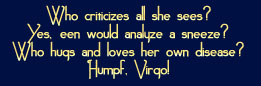
Also known as the Sign of the Craftsman or Critic, Virgo is Negative in polarity (as are Taurus, Cancer, Scorpio, Capricorn and Pisces). The general characteristics of Negative Signs lean toward introversion and prefer to draw upon personal resources rather than look for external stimuli. Such individuals are naturally more receptive, sensitive and nurturing than are the Zodiac Signs of Positive polarity (Aries, Gemini, Leo, Libra, Sagittarius and Aquarius). However, Negative Signs are also likely to be much more cautious, retiring and standoffish than their Positive counterparts with a tendency to keep personal feelings under tight control. Taurus is the most introverted of the Negative Signs (with Virgo a close second).
All Zodiac Signs governed by the Elements of Earth and Water are considered to be Feminine in nature. Thus, Virgo (ruled by earth) is considered Feminine (as are Taurus, Cancer, Scorpio, Capricorn and Pisces). Feminine Signs are traditionally conceived as being more receptive and less active than their Masculine counterparts which are ruled by the Elements of Fire and Air (the Zodiac Signs of Aries, Gemini, Leo, Libra, Sagittarius and Aquarius). Feminine Signs focus primarily on the emotional and material world with particular attention to sensitivity and depth of feeling. Feminine Signs are said to be noctural or night-oriented. Therefore, the term "feminine" should be viewed in the same light as the Yin (or dark) Polarity of the Tao.
Virgo is the natural ruler of the Sixth House of the Zodiac, commonly referred to as the "House of Service, Work and Health" and known in Vedic Astrology as the "Evil Fortune." It signfies the health and strength of individuals as they develop along the path to adulthood, including the personal respect and degree of care a person gives to their body. This House also governs individuals who fall under the care of others but are not relations or kin...servants and employees, for example. It deals with what happens when an individual is called upon to render service and care. It is also the House concerned with family pets and all domesticated animals...particularly the health and well-being of such creatures. The Sixth House is associated with work ethic and the measure of personal integrity as useful and productive citizens of the world. Within the Sixth House is found the rhythm of an individual's day...the side of a person that decides how he or she would like things to transpire over the coming twenty-four hours...the side which plans a personal schedule. In short, the Sixth House presides over the manner in which humankind functions and is governed by the Planet Mercury (also Planetary Ruler of the Third House).
The opposite sign to Virgo is Pisces. From Pisces, Virgo can learn to let go and swim with the current, freely utilizing the inherent fertile imagination. Thus, can Virgo natives learn to accept human imperfections.
Positive Traits: modest, shy, meticulous, tidy, reliable, practical, diligent, analytical and intelligent
Negative Traits: fussy, hypercritical, harsh, conservative, overly-fastidious, overly-conventional, finicky, a perfectionist and a worrier
Likes: lists, hygiene, order, detail, precision, wholesomeness, health foods and perfection (even in minutiae)
Dislikes: squalor, uncertainty, health hazards, sloppy workers and anything deemed to be sordid
This post has been edited by SenatoR on 7 Jun 2008, 12:11
მიმაგრებული სურათი


 ·
·  ასტროლოგია II, ქალი და მამაკაცის ურთიერთობებში...