As the war progressed, Hitler's attention became focused on foreign affairs and the conduct of the war, to the exclusion of all else. Hess, not directly engaged in either of these endeavours, though he felt qualified to do so, became increasingly sidelined from the affairs of the nation and from Hitler's attention; Bormann had successfully supplanted Hess in many of his duties and usurped his position at Hitler's side. Also concerned that Germany would face a war on two fronts as plans progressed for Operation Barbarossa, the invasion of the Soviet Union scheduled to take place in spring 1941, Hess decided to boldly attempt to bring Britain to the negotiating table by travelling there himself to seek meetings with the British government.[54][55][56] He asked the advice of Albrecht Haushofer, who suggested several potential contacts in Britain. Hess settled on fellow aviator Douglas Douglas-Hamilton, the Duke of Hamilton, whom he had never met. On Hess's instructions, Haushofer wrote to Hamilton in September 1940, but the letter was intercepted by MI5 and Hamilton did not see it until March 1941. Hamilton was chosen in the mistaken belief that he was one of the leaders of an opposition party opposed to war with Germany, and because he was a friend of Haushofer.[57][58][59]
A letter Hess wrote to his wife dated 4 November 1940 shows that in spite of not receiving a reply from Hamilton, he intended to proceed with his plan. He began training on the Messerschmitt Bf 110, a two-seater twin-engine aircraft, in October 1940 under instructor Wilhelm Stör, the chief test pilot at Messerschmitt. He continued to practice, including logging many cross-country flights, and found a specific aircraft that handled well—a Bf 110E-1/N—which was from then on held in reserve for his personal use. He asked for a radio compass, modifications to the oxygen delivery system, and large long-range fuel tanks to be installed on this plane, and these requests were granted by March 1941.[60]
After a final check of the weather reports for Germany and the North Sea, Hess took off at 17:45 on 10 May 1941 from the airfield at Augsburg-Haunstetten in his specially prepared aircraft.[61] It was the last of several attempts to depart on his mission; previous efforts had to be called off due to mechanical problems or poor weather.[62] Wearing a leather flying suit bearing the rank of captain, he brought along a supply of money and toiletries, a torch, a camera, maps and charts, and a collection of 28 different medicines, as well as dextrose tablets to help ward off fatigue and an assortment of homeopathic remedies.[54][63][64]
Within weeks of the outbreak of World War I Hess enlisted in the 7th Bavarian Field Artillery Regiment, becoming an infantryman. His initial posting was against the British on the Somme; he was present at the First Battle of Ypres. On 9 November 1914 Hess was transferred to the 1st Infantry Regiment, stationed near Arras. He was awarded the Iron Cross, second class, and promoted to Gefreiter (corporal) in April 1915. After additional training at the Munster Training Area, he was promoted to Vizefeldwebel (senior non-commissioned officer) and received the Bavarian Military Merit Cross. Returning to the front lines in November, he fought in Artois, participating in the battle for the town of Neuville-Saint-Vaast. After two months out of action with a throat infection, Hess served in the Battle of Verdun in May, and was hit by shrapnel in the left hand and arm on 12 June 1916 in fighting near the village of Thiaumont. After a month off to recover, he was sent back to the Verdun area, where he remained until December.[4][5]
Hess was promoted to platoon leader of the 10th Company of the 18th Bavarian Reserve Infantry Regiment, which was serving in Romania. He was wounded on 23 July and again on 8 August 1917; the first injury was a shell splinter to the left arm, which was dressed in the field, but the second was a bullet wound that entered the upper chest near the armpit and exited near his spinal column, leaving a pea-sized entry wound and a cherry stone-sized exit wound on his back.[6] By 20 August he was well enough to travel, so he was sent to hospital in Hungary and eventually back to Germany, where he recovered in hospital in Meissen. In October he received promotion to Leutnant der Reserve and was recommended for, but did not receive, the Iron Cross, first class. At his father's request, Hess was transferred to a hospital closer to home, arriving at Alexandersbad on 25 October.[7]
While still convalescing, Hess had requested that he be allowed to enrol to train as a pilot, so after some Christmas leave with his family he reported to Munich, where he passed the required tests and underwent aeronautical training. By 14 October he had been assigned to Jagdstaffel 35b, a Bavarian fighter squadron equipped with Fokker D.VII biplanes. He saw no action with Jagdstaffel 35b, as the war ended on 11 November 1918, before he had the opportunity.[8]
Hess (right) with his geopolitics professor, Karl Haushofer, circa 1920
Hess was discharged from the armed forces in December 1918. The family fortunes had taken a serious downturn, as their business interests in Egypt had been expropriated by the British.[9] Hess joined the Thule Society, an antisemitic right-wing Völkisch group, and a Freikorps, one of many such volunteer paramilitary organisations active in Germany at the time.[10] Bavaria witnessed frequent and often bloody conflicts between right-wing groups such as the Freikorps and left-wing forces as they fought for control of the state during this period.[11] Hess was a participant in street battles in the spring of 1919 and led a group which distributed thousands of antisemitic pamphlets in Munich.[12][13]
In autumn 1919 Hess enrolled in the University of Munich, where he studied history and economics. His geopolitics professor was Karl Haushofer, a proponent of the concept of Lebensraum ("living space"), which Haushofer cited to justify the proposal that Germany should forcefully conquer additional territory in Eastern Europe.[14][12] Hess later introduced this concept to Adolf Hitler, and it became one of the pillars of Nazi Party ideology.[13][15] Hess became friends with Haushofer and his son Albrecht, a social theorist and lecturer.[12]
Ilse Pröhl, a fellow student at the university, met Hess in April 1920 when they by chance rented rooms in the same boarding house. They married on 20 December 1927 and their son Wolf Rüdiger Hess was born ten years later, in 1937.[16]
აგერ წაიკითხე
თU გინდა დამატებით მასალებსაც მოგაწვდით.
როგორ შეიძლება ესეთ ალალ კაცზე მსგავსი რამე დაწერო.
რუდოლფ

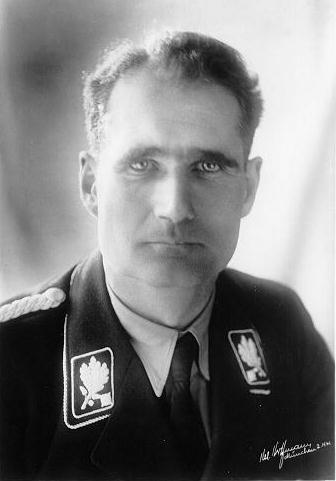 This post has been edited by fallow on 23 Aug 2015, 17:39

 რუდოლფ ჰესის ფანკლუბი